Abstract:
Humans outperform robots in physical interaction, despite current advances in robot learning and control. AI-driven approaches are intrinsically unidirectional, constrained only by temporal causality and boundedness. Physical interaction, however, is dictated by reactive behavior governed by energy conservation, entropy, etc. Robot learning algorithms for physical interaction must therefore interface the information domain with the energy domain. In this talk, I present physics-grounded AI, a unifying framework that integrates coordinate-invariant, energy-consistent robot dynamics with machine learning and generative AI to enable safe, stable, and human-mimetic physical interaction. Inspired by human motor control, the framework enables modular robot control via motor primitives that form a compositional control language, allowing robots to learn interaction strategies from demonstration while preserving physical consistency. I will present my recent work on diffusion-based impedance learning, which bridges generative modeling with interactive control, enabling robots to adapt stiffness and damping autonomously, even across unseen tasks and hardware configurations. The focus application of this talk is robot-assisted physical rehabilitation, where my physics-grounded AI framework allows skilled physical and occupational therapists to imprint their treatment style onto robots, enabling personalized, stable, and safe assistance.
Bio:
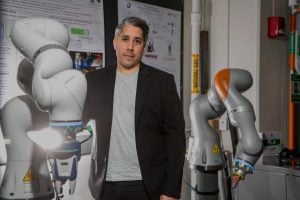
Johannes is a postdoctoral researcher in the MIT–Novo Nordisk AI Fellowship Program, working at the intersection of robotics, motor neuroscience, and AI. His research combines insights from human motor control to create robotic systems that support individuals with neurological and physical impairments. Johannes is also a Lecturer and Lab Professor for one of MIT’s flagship undergraduate Mechanical Engineering courses in Instrumentation and Measurement. Before MIT, Johannes spent nine years at KUKA, where he led research in contact-rich robotic manipulation and physical Human-Robot Interaction. As a Senior Research Engineer in Corporate R&D, he helped shape technologies that now power real-world products. His work led to ten patents, five of which were successfully transferred into industry. Johannes earned his PhD with highest distinction under the supervision of Prof. Stefano Stramigioli (University of Twente) and Prof. Neville Hogan (MIT). His thesis applied Differential Geometry to develop robot controllers that are safe, stable, and energy-aware, and was honored as a finalist for the European Georges Giralt PhD Award, for which only four researchers across Europe were selected. Outside the lab, Johannes mentors students in MIT Engineers Without Borders and enjoys helping them grow as future engineers.
LinkedIn ⋅ GitHub ⋅ GoogleScholar