Abstract:
I will present battery-free autonomous microrobots that can fly in the wind or drive independently on the ground using microwatts of harvested energy from light or radio waves. These mobile sensing platforms could have a transformative impact in applications from agricultural monitoring, hazardous infrastructure inspection, exploring extraterrestrial environments, and reconfiguring camera networks. This work challenges the conventional assumption that locomotion is beyond the reach of battery-free robots, demonstrates several approaches for achieving autonomous operation in realistic application scenarios, and opens up a discussion on the practicality of large scale mobile sensor deployments in remote environments. I will discuss how miniaturizing robots to near the gram scale can significantly reduce their energy requirements, which when combined with cyber-mechanical innovations can enable autonomous battery-free mobility. I will explain how we leveraged origami to create shape changing leaf-out origami robots that can fly in the wind to disperse sensors. I will also explain how we leveraged intermittent motion to enable battery-free robots that can roll around on the ground. Finally, I will present preliminary work towards creating miniaturized helicopters and jumping robots.
Bio:
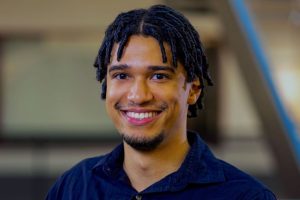
Kyle Johnson is a sixth year Ph.D. Candidate in Computer Science & Engineering at the University of Washington (UW) and the Co-founder and Executive Director of the outreach nonprofit AVELA – A Vision for Engineering Literacy & Access. He works with Professors Vikram Iyer and Sawyer Fuller to explore how combinations of low-power actuation and control mechanisms can be used to create autonomous microrobots optimized for resource constrained applications. These include technologies for battery-free onboard actuation, wireless communication, remote sensing, and control. Kyle is also passionate about helping decrease opportunity gaps in the education system for underrepresented minority youth. He has supported 150+ different AVELA instructors in teaching to over 2,000 K-14 students each academic year since 2023. Findings from this wide-scale outreach are viewable in IEEE’s World Engineering Education Forum (WEEF) and Black Issues in Computing Education (BICE) Conferences. Kyle’s work has been recognized by the Quad Fellowship, NSF Graduate Research Fellowship Program, Amazon Science Hub Fellowship, Washington NASA Space Grant Consortium, and the National GEM Consortium. His publications have appeared in Science Robotics and the ACM MobiCom Conference and have garnered widespread media attention including by the NSF, GeekWire, Popular Science, and IEEE.