Abstract: This talk explores how partial differential equation (PDE)–based physics priors can provide a foundation for scalable and generalizable algorithms in robot motion learning. Rather than searching over discrete graphs or samples, it formulates and learns the solution to the motion-planning problem as a continuous value function governed by Hamilton–Jacobi (HJ) PDEs. These methods enable self-supervised value-function learning without reliance on expert trajectories or trial-and-error interaction. The learned value functions yield fast inference of motion plans and demonstrate strong scalability across complex, high-dimensional, and constraint-rich navigation and manipulation tasks. The talk also introduces an HJ PDE–derived mapping representation that unifies perception and planning: unlike occupancy grids or signed distance fields, it encodes motion-feasible geometry in a form naturally structured for continuous decision-making. Together, these developments outline a unified, numerically grounded framework for robot motion planning and control through the lens of physics-informed learning.
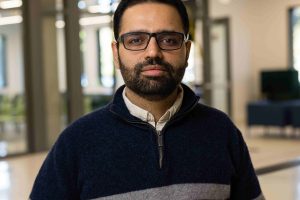
Bio: Ahmed Qureshi is an Assistant Professor in the Department of Computer Science at Purdue University, where he directs the Cognitive Robot Autonomy and Learning (CoRAL) Lab. His group pursues fundamental and applied research in robot motion planning and control, with the goal of developing methods that can leverage the laws of physics to plan and act in real time with minimal or no expert demonstrations. His research spans scalable and efficient motion planning, dexterous manipulation, active perception, and multi-agent task and motion planning. Dr. Qureshi currently serves as an Associate Editor for IEEE Transactions on Robotics (TRO) and IEEE Robotics and Automation Letters (RA-L), and in 2024, he received the Outstanding Associate Editor Award from IEEE RA-L. He has also served on the program committees of leading robotics conferences, including RSS, ICRA, IROS, and CoRL. His contributions have been recognized with spotlight and best paper awards at top academic venues. He earned his B.S. in Electrical Engineering from NUST, an M.S. in Engineering from Osaka University, and a Ph.D. in Intelligent Systems, Robotics, and Control from the University of California, San Diego.